2 days in Busan, split the way the city actually is
Busan is not a city you cross casually. The old town in the west and the beach districts in the east sit 15 km apart, and trying to mix them wastes an hour on the subway each way. So this splits cleanly: one day west, one day east.
- Jagalchi Market closes on Tuesdays — the 1st and 3rd of each month, sometimes the 5th. Not Sundays, which is what most guides say.
- The Sky Capsule sells out. Book ahead, and note the price is per capsule, not per person — ₩50,000 split four ways is ₩12,500 each.
- Taejongdae's Danubi train has been suspended since July 2026 after two accidents. A free shuttle bus runs instead — check before you go and be ready to walk the 4.3 km loop.
Getting there and getting around
| From Seoul | KTX from Seoul Station to Busan Station, about 2h 20m and around ₩59,800 one way, over a hundred departures a day. Book 5–7 days out for Friday evenings, Sunday afternoons and holidays. Busan Station is in the old town and on Metro Line 1, so Day 1 below starts within walking distance of where you arrive. |
|---|---|
| Rail pass? | The foreigner-only KORAIL Pass does not pay for itself on a simple Seoul–Busan return — two tickets come to about ₩120,000 against a pass starting higher. It only makes sense across a multi-city route. |
| Transport card | Your Seoul T-money works in Busan — do not buy a second card. Busan Metro is ₩1,600 for the first 10 km, ₩1,800 beyond (many guides still say ₩1,300 — that rose in 2024). A ₩6,000 day pass breaks even at four rides, which Day 2 will exceed. Children under 13 ride free. |
| Visit Busan Pass | ₩55,000 for 24 hours, ₩85,000 for 48. Worth it only if you are doing two or three paid attractions a day — and much of this itinerary (Gamcheon, Jagalchi, Taejongdae, Yonggungsa) is free. It starts to pay off if you pair the Beach Train with BUSAN X the Sky. |
The old town: Gamcheon, the market, the port
Everything today is in the west, within about 2 km. Metro Line 1 links it all, and much of it is walkable.
Avoid: 1st and 3rd Tuesday (Jagalchi closed)
- 09:00
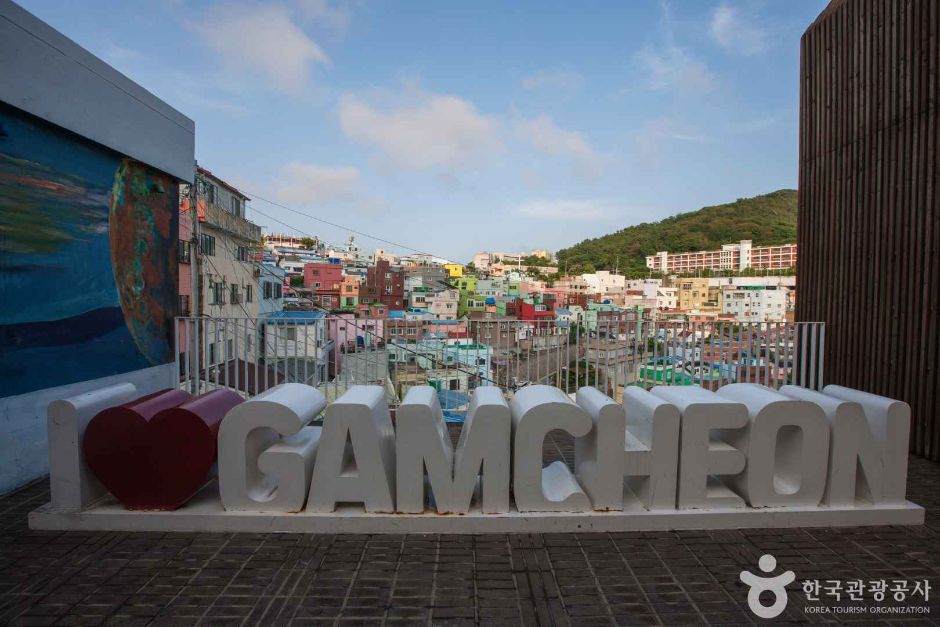
Gamcheon Culture Village
Pastel houses stacked up a hillside in terraces — originally a refugee settlement from the Korean War, repainted as an art project in 2009. Free, no gates; the 09:00–18:00 hours you see published are for the information centre and shops. Arrive at opening to beat the tour buses. Buy the ₩2,000 stamp map at the information centre — it walks you through the alleys you would otherwise miss.
People live here. Keep your voice down, stay out of private staircases, do not photograph into doorways, and note that drones are prohibited.
 12:001.7 km
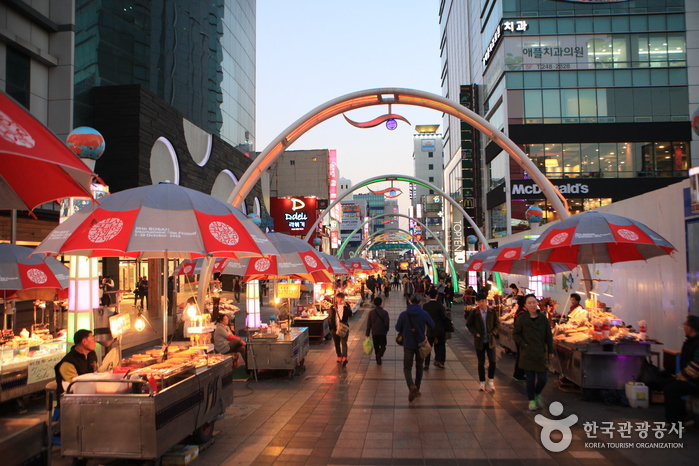
BIFF Square and Gukje Market
BIFF Square is where the Busan International Film Festival began, its pavement set with directors' handprints, and it is one of the country's best street-food alleys — try the ssiat hotteok, a seed-stuffed pancake that is a Busan speciality. Gukje Market runs straight into it: a sprawling traditional market that grew out of postwar trading.
 14:00600 m
Jagalchi Market
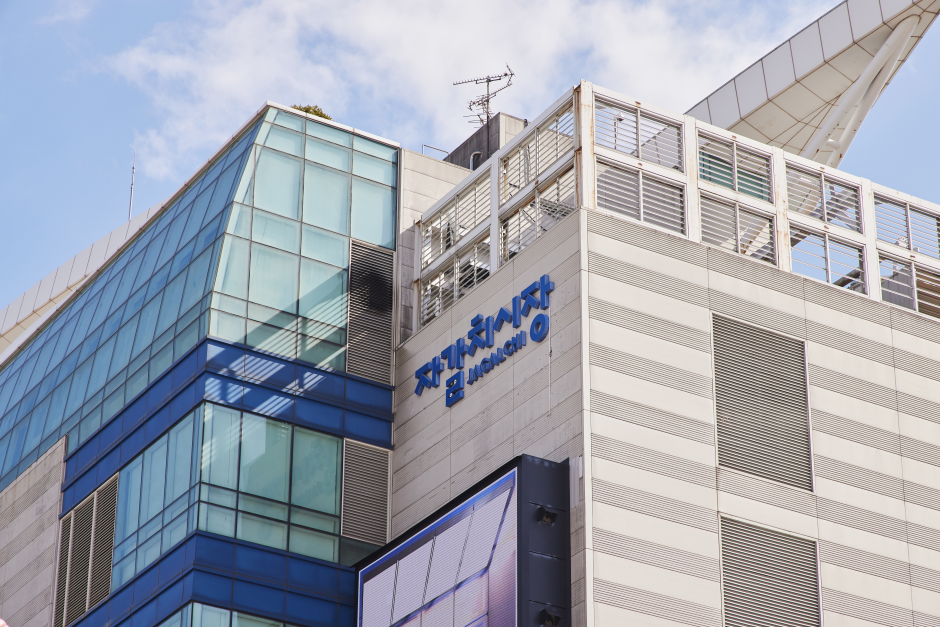
Korea's largest seafood market, run largely by women — the jagalchi ajumma are a Busan institution. Open 05:00–22:00; pick something downstairs and they will cook it for you upstairs. Closed the 1st and 3rd Tuesday of each month.
 16:00
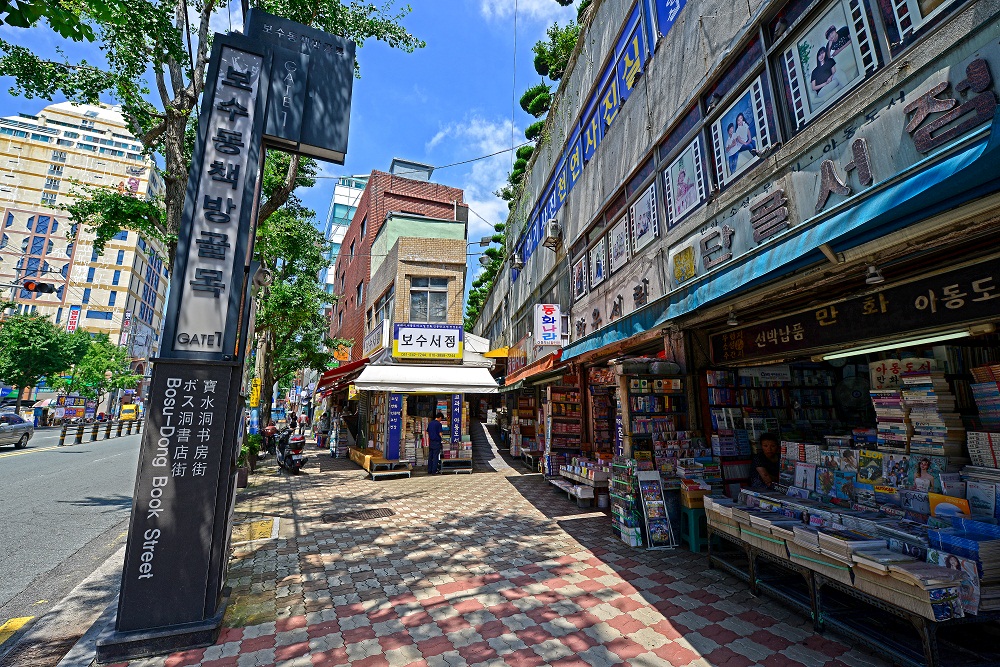
16:00Bosu-dong Book Street
An alley of second-hand bookshops that started when refugees sold off their libraries to survive. Quiet, narrow, and one of the few places in Korea where that period is still physically visible rather than commemorated.
 Late afternoon2.1 km
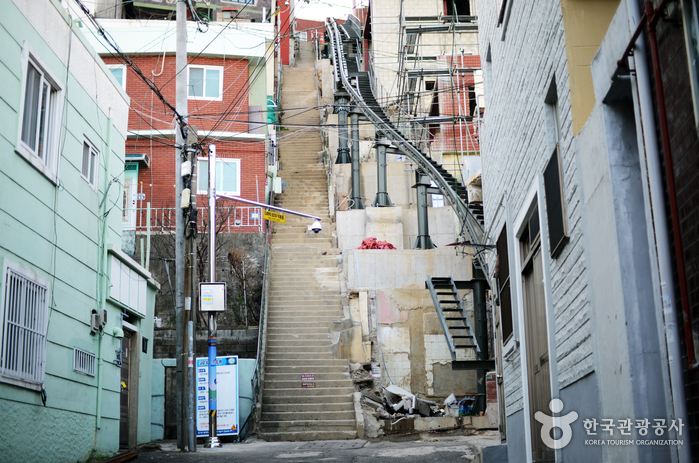
168 Stairs, or Huinnyeoul
The 168 Stairs climb the hillside above the port in a single straight flight — there is a monorail if you would rather not. Alternatively cross to Huinnyeoul Culture Village on Yeongdo, a clifftop row of houses above the sea that was the setting for several Korean films.
The coast: Haeundae, the Sky Capsule, Gwangalli
The east side. Beaches, a coastal railway on a disused track, and the bridge that defines the city’s skyline.
 Morning
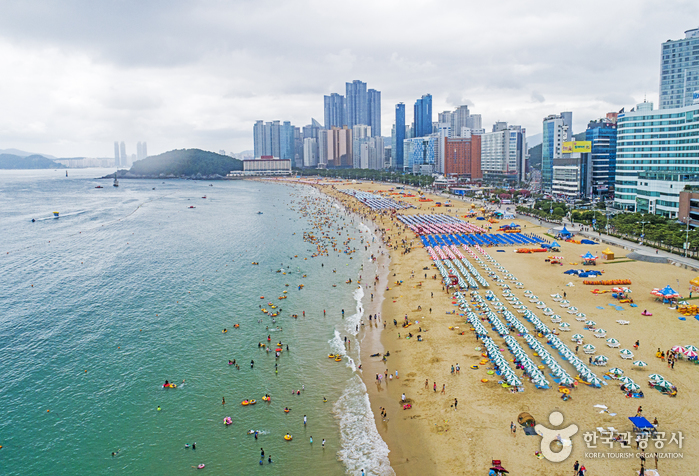
Haeundae Beach
Korea's most famous beach, 1.5 km of sand backed by high-rises. Fifteen minutes on foot from Haeundae Station (Line 2). Walk east along the sand to Mipo, where the next stop starts.
- Midday
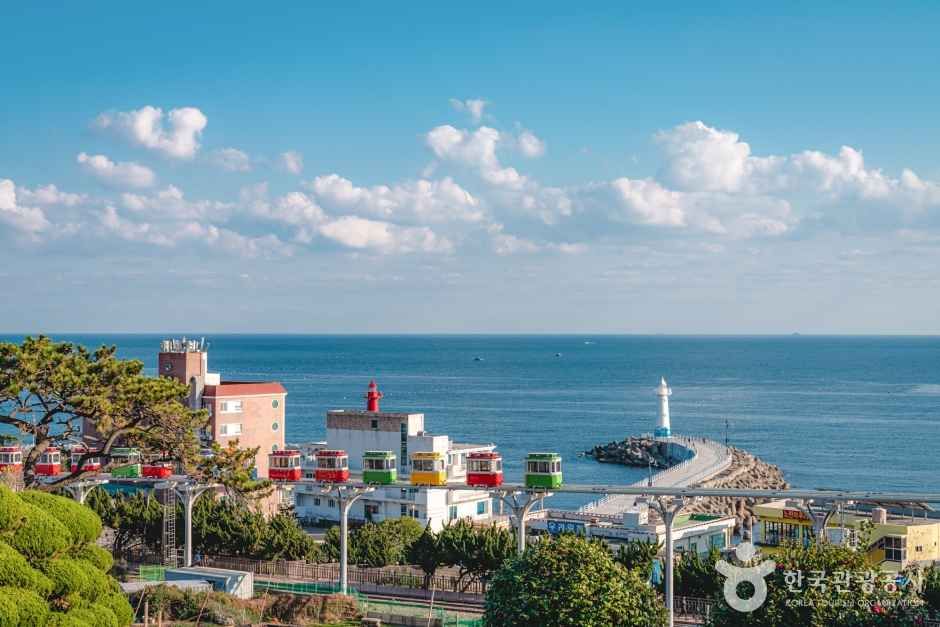
Blueline Park: Sky Capsule and Beach Train
A disused coastal railway reborn as two rides. The Sky Capsule is a four-seat pod running 2 km between Mipo and Cheongsapo at walking pace, about 30 minutes. Priced per capsule, not per head — ₩40,000 for two up to ₩50,000 for four, one way. Book ahead; it sells out.
Book Mipo → Cheongsapo if you can: that track runs on the seaward outer edge with unbroken ocean views (sit on the right). If it is sold out, the reverse direction is a real fallback — easier to get, and it faces the sunset.
The Beach Train continues past Cheongsapo to Songjeong, 4.8 km in all. ₩8,000 one ride, or ₩16,000 for the all-station pass, which is the one to buy if you want to hop off at the skywalk and the observatory along the way. Ride it to the far end and you are within a short bus ride of Haedong Yonggungsa, the cliffside temple below.
 Afternoon
BUSAN X the Sky
An observation deck on the 98th to 100th floors of the tallest building in the city, back at Haeundae. Worth it for the view down the coast you have just travelled — and it is one of the attractions the Visit Busan Pass covers, if you bought one.
- Evening3.8 km
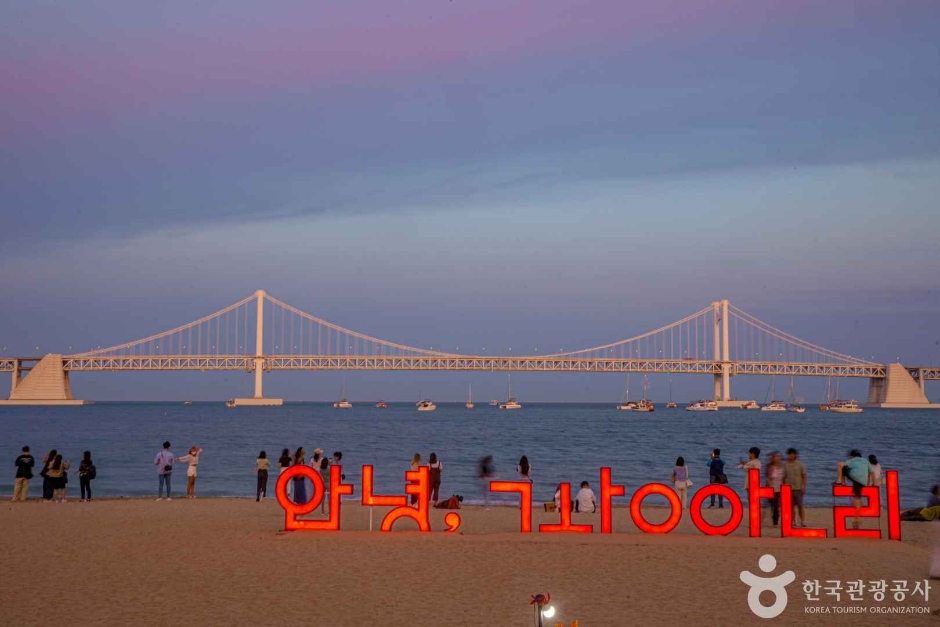
Gwangalli Beach
The evening beach. Gwangalli faces the Gwangan Bridge, which lights up after dark, and the seafront is a solid line of bars and restaurants. Drone light shows run over the water on many weekend evenings. This is where Busan residents actually go.
If you have a third day
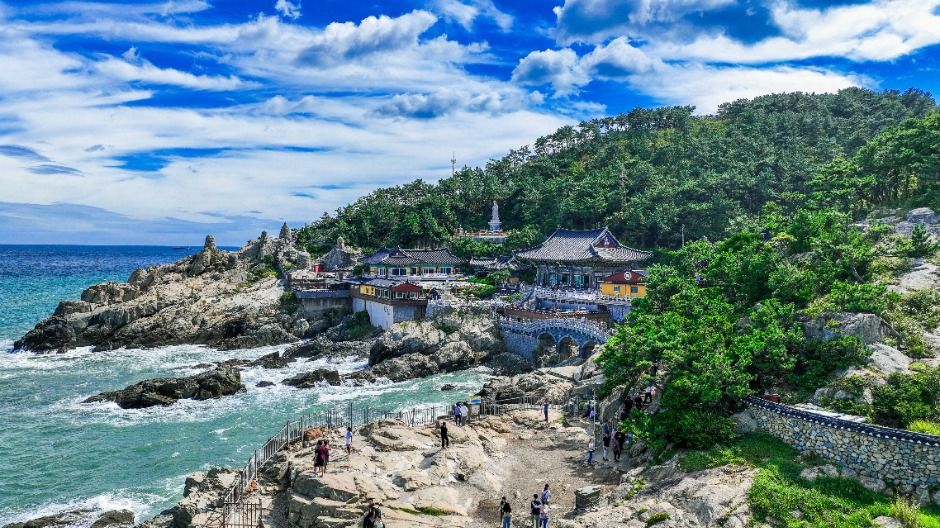
The obvious addition is Haedong Yonggungsa, a temple built onto the rocks at the water's edge on the north-east coast — almost every Korean temple is inland and up a mountain, which is exactly what makes this one worth the trip. It is free, opens around dawn, and sits 4 km past Cheongsapo, so it pairs naturally with the Beach Train if you ride to the end of the line rather than turning back.
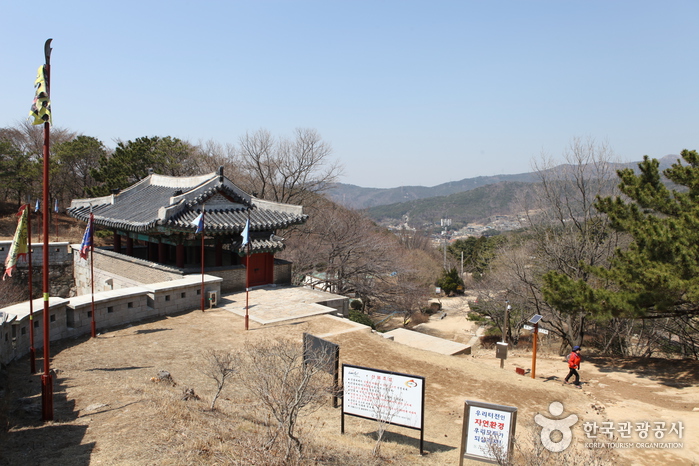
Inland, Geumjeongsanseong Fortress is the longest fortress wall in Korea, running along the ridge above the city. Beomeosa, a 7th-century mountain temple with a well-known foreigner-friendly templestay, sits on the same mountain at the northern end of Metro Line 1 — free, and about an hour from the centre. Aim to arrive before 16:00.
Check what is on while you are here
This autumn the Busan Fireworks Festival fills Gwangalli Beach on 7 November, and the Jinju Lantern Festival is an easy day trip until 18 October. Busan also hosts the country's biggest film festival each autumn and a steady run of concerts and exhibitions. Put your dates into the Trip Planner, or browse everything in Busan.
Busan this weekendWhere to stay in BusanBusan Fireworks 2026Busan: places & eventsBeaches & islandsTraditional marketsNeighbourhoodsTrip Planner

